Landing page prices in 2026: How much will you spend?
8 min read
November 22, 2025
Website design & development
Ognjen Marinkovic
10 min read
November 27, 2025
Most small businesses pay around $3,000 to $7,000 for a professional website. That gets you custom design, mobile optimization, and basic SEO. If you're on a tight budget, you can start at $1,000. But if you need e-commerce, you're looking at $10,000 or more.
Timeline? You're looking at 3-6 weeks for a standard website. E-commerce takes longer, usually 8 weeks or more.
Ongoing costs are pretty straightforward. Hosting runs you $60 to $300 a year. Your domain is another $10 to $50 annually. And if you want someone to keep things updated, that's an extra $500 to $2,000 per year. But that last one's optional.
What does a website actually cost? If you're looking into getting a website for your business, I bet this question has been on your mind. And look, you're definitely not the only one. Plenty of business owners stress about getting hit with unexpected fees or spending way more than they planned.
Here's the truth: you're looking at anywhere from $1,000 to $10,000 or more. And if you don't know what to look for, it's pretty easy to either pay too much or get stuck with a site that just doesn't do what you need it to.
Your website is basically like having a store, just online. You can go simple or fancy, same as you would with a brick-and-mortar place. But here's the cool part: your website never closes. It's out there working for you at 2 in the morning, connecting with people who might never walk past your physical location. So yeah, it's worth doing right.
Here's what I'll walk you through:
What does a website actually cost? If you're looking into getting a website for your business, I bet this question has been on your mind. And look, you're definitely not the only one. Plenty of business owners stress about getting hit with unexpected fees or spending way more than they planned.
Here's the truth: you're looking at anywhere from $1,000 to $10,000 or more. And if you don't know what to look for, it's pretty easy to either pay too much or get stuck with a site that just doesn't do what you need it to.
Your website is basically like having a store, just online. You can go simple or fancy, same as you would with a brick-and-mortar place. But here's the cool part: your website never closes. It's out there working for you at 2 in the morning, connecting with people who might never walk past your physical location. So yeah, it's worth doing right.
Here's what I'll walk you through:
Understanding the cost to build a website starts with knowing your project scope. Website design pricing ranges from $1,000 to $10,000+ depending on complexity.

Here's what you get at each level:
What's included: This package covers 1-3 pages (Home, About, Contact) with basic design using templates, a contact form, mobile-friendly layout.
Timeline: 2-4 weeks
Best for: New businesses, personal portfolios, event websites, testing an idea.
What you don't get: Custom design, blog, SEO optimization, complex features.
What's included: This package includes 3-15 pages with custom design (not a template), a blog section, contact and newsletter forms, custom graphics, basic animations, Google search optimization.
Timeline: 3-6 weeks
Good for: Established businesses, professional services, restaurants, service companies.
What you don't get: No online store functionality, user accounts, advanced integrations.
What's included: This package offers unlimited pages with fully custom design, an online store with shopping cart, user accounts and logins, custom features and tools, payment processing, complex animations, software integrations, full accessibility.
Timeline: 8+ weeks
Good for: Online stores, marketplaces, membership sites, web applications, enterprise companies.
What you don't get: Nothing - this is a complete package.
Use our interactive calculator to get an instant estimate based on Designow's pricing standards:
Most small businesses spend around $3,000 to $7,000 for a professional website. That gets you 8-12 pages, custom design (not templates), contact forms, mobile optimization, and basic SEO setup.
Timeline? You're looking at 3 to 6 weeks.
Here's how the pricing breaks down. If you only need design and you'll handle development yourself, that's $1,500 to $3,000. A complete package with design plus development runs $3,000 to $7,000, and you get a website that's ready to launch.
Need an online store? That bumps the total to $6,000 to $12,000.
Don't forget the ongoing costs. Hosting is $60 to $300 a year. Your domain is another $10 to $50 annually. And if you want someone to keep things updated, that's an extra $500 to $2,000 per year. But that last one's optional.
Want to save money without sacrificing quality? Keep reading and we'll show you how to cut these costs by 40 to 60%.
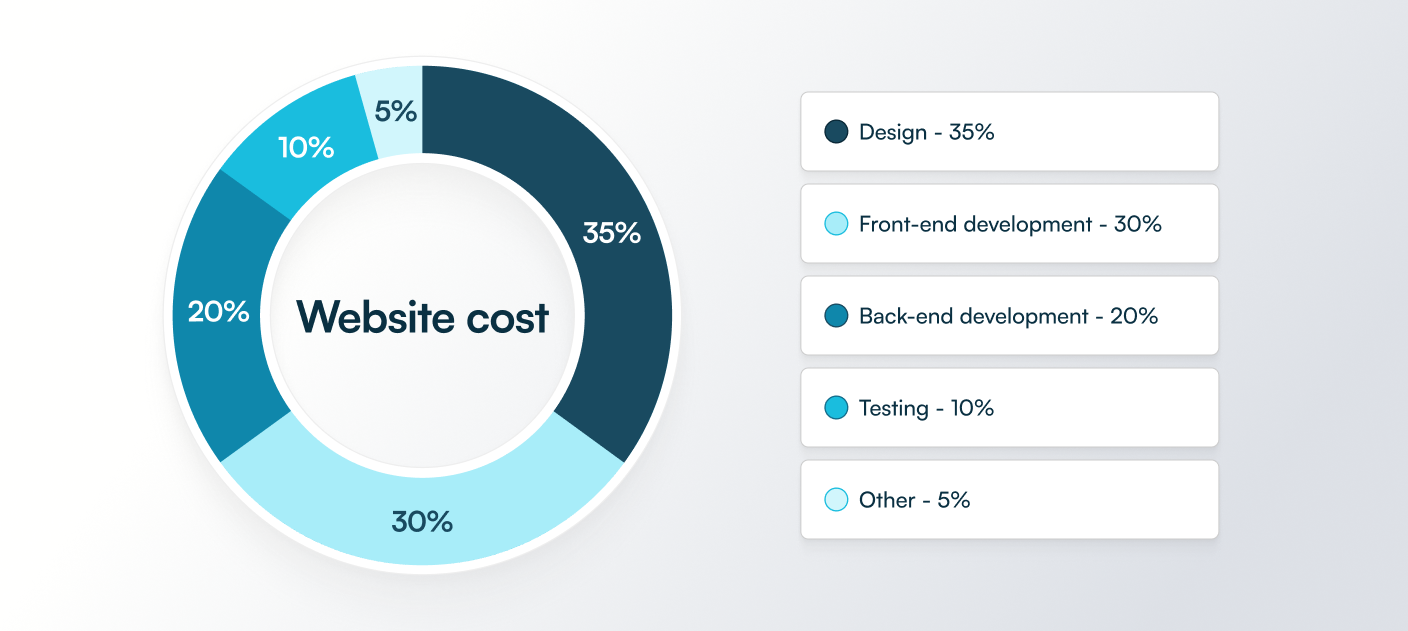
What am I paying for? Your money goes into a few different things. First, there's the design work: figuring out what your site needs, sketching out the layout, and making it look good. Then someone has to actually build it - that's the front-end coding (the stuff you see) and back-end development (all the behind-the-scenes functionality, like your content management system and databases). Finally, there's testing and launch, where they make sure everything works, fix bugs, and get your security sorted out.
Think about it like building a house. You need an architect to design it, a construction crew to build it, materials like lumber and concrete, and then someone to do the finishing work. Your website's the same deal. The designer is your architect. Developers are your construction crew. Hosting and your domain name are like your land and materials. And testing is making sure the doors actually open and the lights turn on. You need all of it.
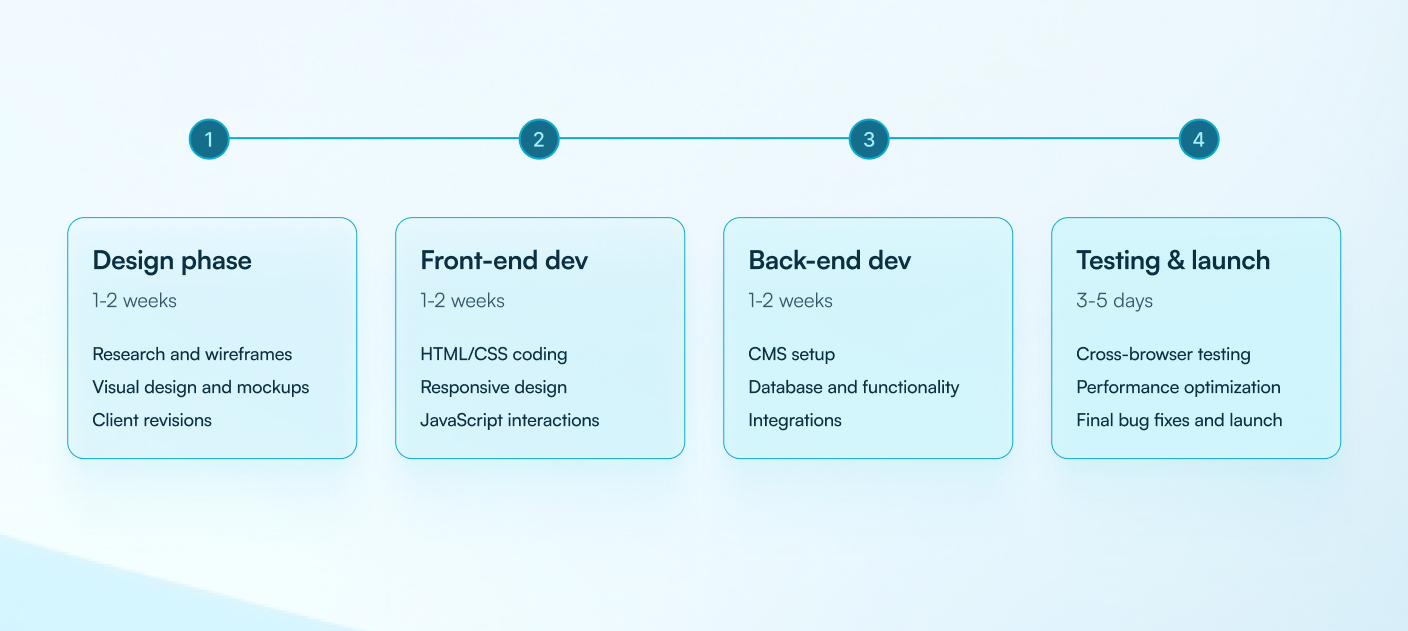
More pages and features = higher cost. Here are real examples:
The range depends on design complexity, features and who builds it.
Wondering which design approach to choose? Here's the honest breakdown:
Each feature adds to the cost:
Web design rates vary based on experience, which impacts both quality and price:
Web design rates and website development cost vary significantly by provider in 2026. Web development timelines and quality also depend on your provider choice.
Here's a complete breakdown:
Your time investment: 20-100 hours
How it works: You use drag-and-drop tools like Wix, Squarespace, or Webflow to build your site yourself.
Cost breakdown: Platform subscriptions run $0-$50/month, domains cost $10-$50/year, premium templates add $0-$100, and apps/plugins range from $0-$20/month.
Best for: Solopreneurs, testing ideas, very tight budgets.
Reality check: You'll spend 40-100 hours learning the platform and building your site. Calculate your time at your hourly rate, often the "cheap" option isn't cheap.
For a detailed website builder comparison, read our Webflow vs WordPress guide.
Timeline: 3-8 weeks (based on average web designer hourly rate of $75-$125)
How it works: You hire an independent designer/developer who handles the entire project.
Cost breakdown: Design work costs $1,000-$4,000, development runs $1,500-$5,000, and most packages include 2-3 revision rounds.
Best for: Small businesses wanting custom design without agency prices.
Reality check: Quality varies dramatically. Always check portfolios and ask for references.
Timeline: 6-12 weeks minimum
How it works: A team of specialists (designers, developers, project managers) handles your project.
Cost breakdown: Discovery & strategy costs $1,000-$5,000, design runs $3,000-$15,000, development ranges $5,000-$25,000, and testing & launch adds $1,000-$5,000.
Best for: Established businesses, companies with complex needs, enterprises.
Reality check: You're paying for expertise, reliability, and peace of mind. Agencies rarely disappear mid-project.
Timeline: Continuous work
How it works: Fixed monthly fee for on-demand design and development work in 2026. Submit requests, get them completed, repeat.
Pricing tiers:
Best for: Ongoing needs, continuous improvements, multiple landing pages, businesses that need flexibility
The build cost is just the beginning. Your website needs ongoing care, like a car needs gas and maintenance.
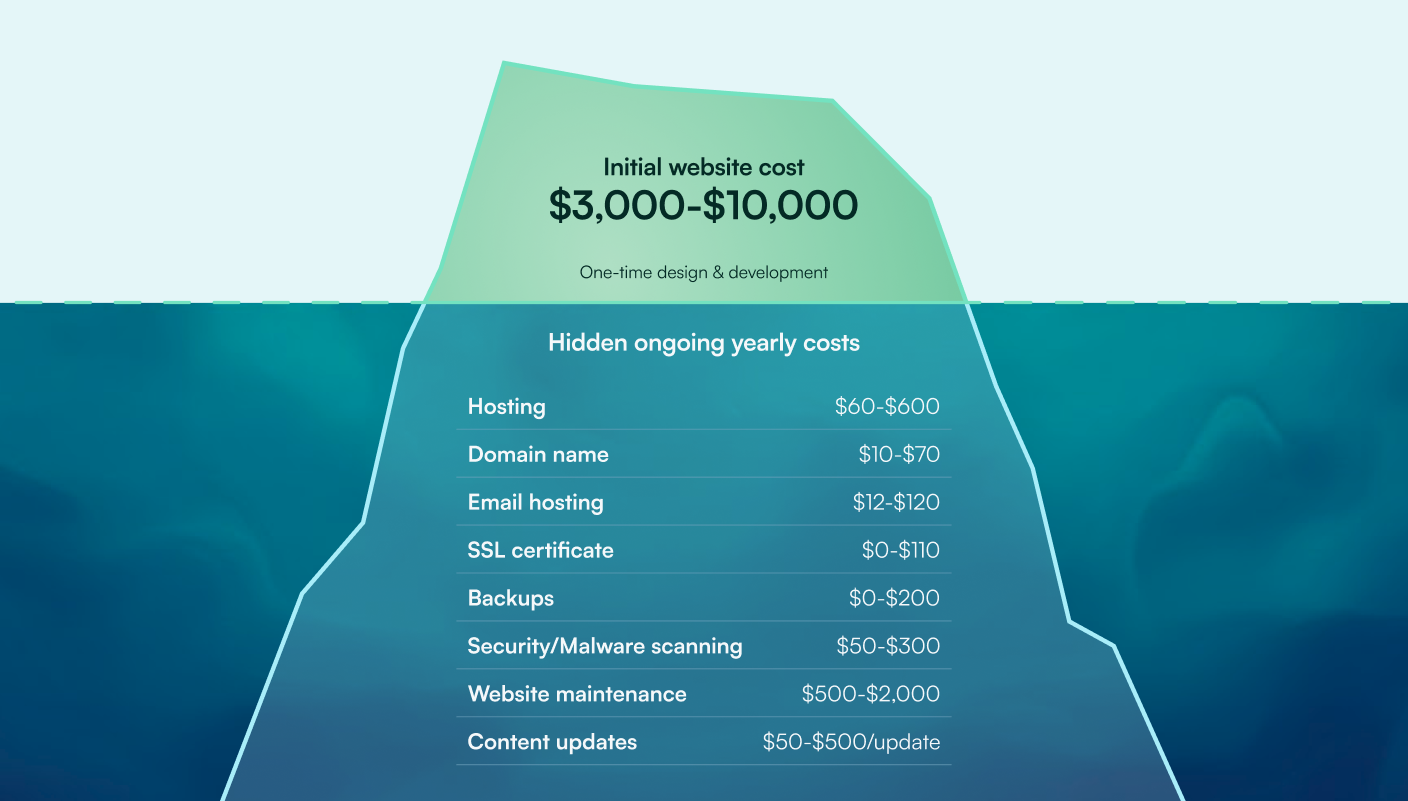
Budget $600-$3,000+ per year for:
Pro tip: Skipping maintenance is like never changing your car's oil. Your site will slow down, break or get hacked. Budget for it from day one.
Professional photography: $500-$5,000 Professional photography covers product shots for e-commerce, team headshots, and office/location photos.
Professional copywriting: $500-$3,000 This includes homepage copy, service page descriptions, about page story, and product descriptions.
Logo and branding: $300-$5,000 This is a separate project from web design that includes logo, color palette, fonts, and a brand guidelines document.
Post-launch costs: Bug fixes for the first 30 days are usually included. Feature additions cost $500-$3,000 each, and design updates run $1,000-$5,000 annually.
Complete website launch checklist
Many people confuse these two. Here's the clear distinction:
Check our guide on landing page costs - they typically range from $1,000 to $5,000 depending on how complex they are.
Full websites suit businesses needing blogs and content marketing, multiple service pages, about and team pages, resources sections or complete online presences.
Use landing pages when you're testing new products or offers, running paid advertising campaigns, launching rapidly (days, not months) or focusing on single conversion goals. Landing pages provide speed and focus without multi-page website complexity.
Pro tip: Start with landing page MVPs. Add pages later as you validate market fit. Most startups waste money building 20-page websites before proving anyone wants their product.

A redesign updates the parts that aren't working while keeping the good stuff. A complete rebuild means starting fresh - it gives you more freedom but takes more time and money. Switching from WordPress to Webflow makes editing easier, but you might need a developer's help if you're using complicated plugins.
Already have a website but need to update it? Here's what website redesign pricing looks like in 2026:
What's included: This package preserves existing content while delivering a complete new visual design, improved user experience, modern layout and styling, SEO migration that preserves rankings, mobile optimization, updated CMS/platform if needed.
Timeline: 4-8 weeks
Best for: Outdated sites (3+ years old), poor conversion rates, not mobile-friendly, rebrand needed
What's included: This package covers the homepage plus 2-3 key pages, keeping the existing structure while providing a visual refresh only. It updates colors, fonts, and images, includes minor layout improvements.
Timeline: 2-4 weeks
Best for: Recent sites needing visual updates, limited budget, testing new design direction
Different industries have different website needs in 2026. An online store requires different features than a law firm or restaurant.
These ranges assume 8-12 pages, custom design, and standard features for each industry.
Need a single landing page? Landing page costs range from $500-$2,000 depending on complexity and features.
What if I don't have $5,000 just sitting around?
Look, not everyone can drop that kind of cash all at once. Most web designers get that, so here's how they typically handle payments.
The standard way is a 50/50 split. You pay half upfront to lock in your spot and get the design work started. Then you pay the other half when everything's done, right before your site goes live.
For bigger projects (we're talking $10,000 and up), they usually break it into three chunks: a third when you start, another third once you approve the design, and the final third when the site launches.
Some agencies will even let you pay monthly. You might pay somewhere between $500 and $1,500 a month for 6 to 12 months. Or they'll set you up on a retainer where you pay the same amount each month while they work on your site.
A couple things to keep in mind: most payment plans don't charge interest, but some agencies will hit you with a small processing fee (usually 1-3%). And this is important: always get the payment terms in writing. And seriously, never pay the full amount upfront for a one-time project. If someone asks for 100% before they start, that's a red flag.
Important notes: Payment plans usually don't include interest, though some agencies charge a 1-3% processing fee. Always get payment terms in writing, and never pay 100% upfront for one-off projects.
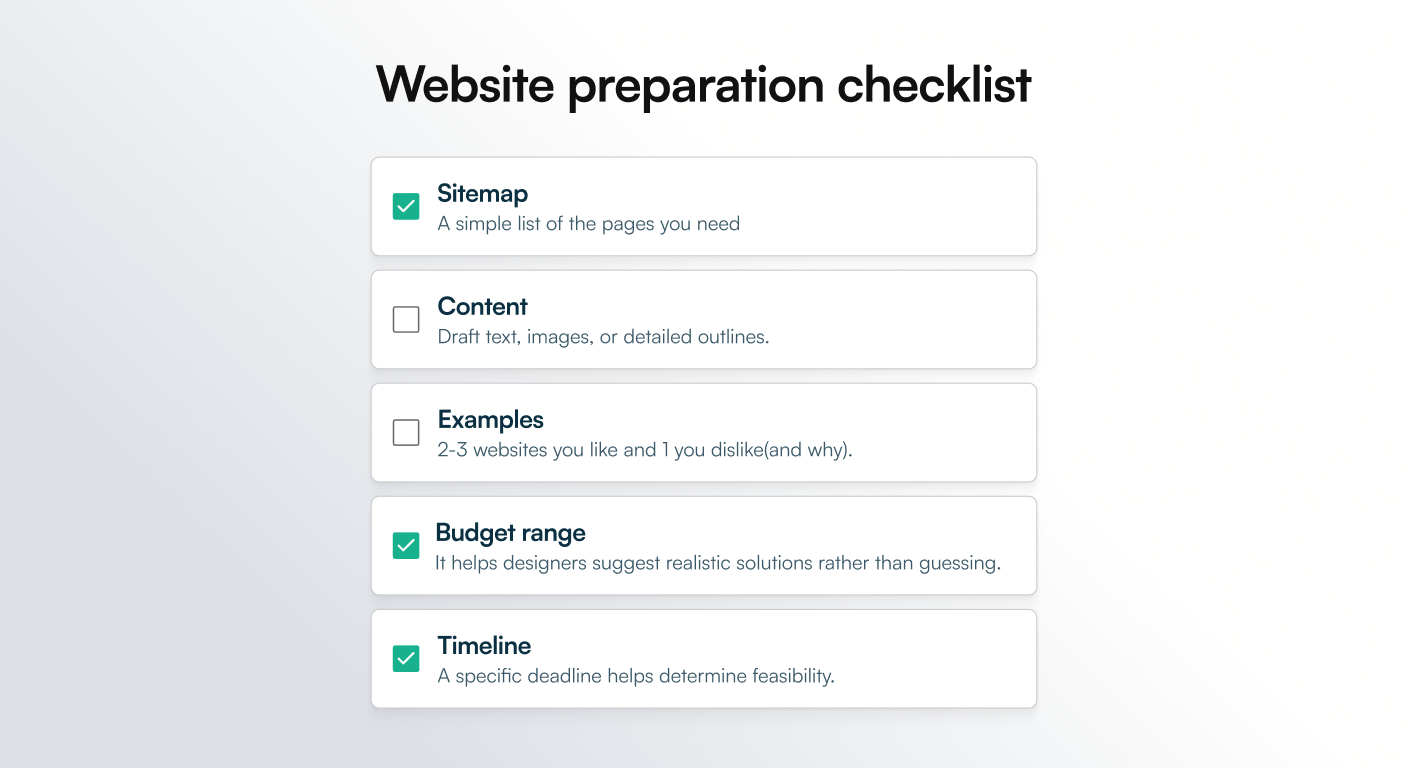
You can cut costs significantly without sacrificing quality. Here's exactly how:
Savings: $500-$2,000
Write your own page copy and gather images before hiring a designer. Designers charge $50-$150/hour for content creation.
What to prepare: Gather text for all pages, your logo in high resolution, photos and images, contact information, and social media links before you start.
Savings: $2,000-$4,000
Template design costs 50% less than custom design.
Good middle ground: Buy a premium template for $50-$100, then hire a designer to customize it for $1,500-$3,000. Total cost: $1,550-$3,100 versus $5,000-$8,000 for fully custom.
Savings: $1,500-$3,000
Launch with 3-5 essential pages. Add blog and extra features after you generate revenue.
Phase 1 (Launch): Start with Home, About, Services, and Contact pages.
Phase 2 (3-6 months later): Add your blog, case studies, and additional service pages once you're generating revenue.
Savings: $2,000-$5,000
Don't pay for features you won't use in the first 6 months. Skip the live chat widget (saves $500-$1,000), complex animations (saves $800-$1,500), booking system if you don't need it yet (saves $1,500-$3,000), and member areas (saves $2,000-$4,000).
Savings: $3,000-$8,000
Experienced freelancers cost 40-60% less than agencies for similar quality.
Example: An agency charges $12,000 while an experienced freelancer costs $6,000 for the same project. That's $6,000 in savings.
Original quote: $7,000
Reductions:
Total savings: $5,800
New cost: $1,200
Pro tip: The more prepared you are, the lower your costs. Designers often charge extra for "figure it out as we go" projects because they take twice as long.
Before you try to cut corners, understand what you're risking:
People form an opinion about your website in 0.05 seconds (Google Research). That's faster than a blink.
A clean interface can increase conversions by up to 200% (Forrester). That means double the leads or sales from the same traffic.
75% of people judge credibility based on design (Stanford Research). An outdated or poorly designed site screams "unprofessional."
Websites that load in 2 seconds show a 9% bounce rate. At 5 seconds it climbs to 38% (Cloudway whitepaper). Every second of delay costs you real money.
It's like turning away revenue before it even has a chance to reach you.
Avoid these common mistakes that waste money:
Problem: Removes your leverage if problems arise
Standard: 50% down, 50% at launch
Problem: $1,000 website from inexperienced designer often needs $2,000 rebuild within a year.
Better investment: Pay $3,000 to experienced designer vs $1,000 + $2,000 rebuild = $3,000 total (plus lost time and frustration)
Problem: Cheap shared hosting ($5/month) causes slow load times and poor SEO
Solution: Budget $20-30/month for decent performance
Why it matters: 1 second delay = 7% fewer conversions
Problem: Content changes, security updates, and bug fixes cost $500-$2,000/year
Solution: Set aside $50-150/month for maintenance
Problem: Booking systems, member areas, and live chat cost $1,000-$3,000 each
Solution: Only add features you'll use in first 3 months
Ask yourself: Will I use this weekly? Does it directly generate revenue? Can I add it later? If the answers are no/no/yes, skip it for now.
Problem: Disputes over scope, revisions, timeline
Solution: Always get a written agreement covering exact deliverables, number of revision rounds, timeline milestones, payment schedule, and what happens if the project is cancelled.
What you'll pay depends on what you need and how complex your site is. Here's a quick breakdown to help you figure out where you fit:
Quick decision guide:
Here's how I'd think about it: your website isn't just money going out the door. It's an investment. A good site makes you look credible, turns more visitors into customers, and brings in new business around the clock. It should pay for itself.


$4,500 is the realistic budget for most small businesses in 2026. Costs range from $1,000-$3,000 for basic sites (3 pages) to $10,000+ for custom platforms with online store functionality.
Most small businesses spend $3,000-$7,000 for a professional website. This covers 8-12 pages, custom website design (not templates), contact forms, mobile optimization, and basic SEO setup. Timeline: 3-6 weeks. Design only costs $1,500-$3,000, while design + development runs $3,000-$7,000.
Four main factors determine website cost: (1) Scope and complexity - more pages and features increase cost, (2) Custom vs template design, (3) Designer experience level, and (4) Who builds it (DIY, freelancer or agency).
The flexible retainer is $2,999/month for unlimited edits. Pause or cancel anytime.
Beyond the initial build, budget $600-$3,000+ per year for: hosting ($60-$600/year), domain name ($10-$50/year), SSL certificate ($0-$110/year), and website maintenance ($500-$2,000/year).
Get everything you need in one place, from branding to Webflow. Fast, flexible, and built for startups.